
Dry fog
Dry fog dust suppression systems
Capture fine, respirable dust inside chutes, hoppers and transfer points using fog-sized droplets — adding so little moisture that the material stays practically dry.
- Site survey & system design
- Supply, installation & AMC
- Qatar & GCC coverage
What is dry fog?
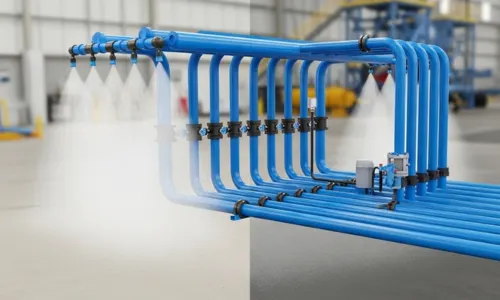
Dry fog is a cloud of very fine droplets — typically around 10 microns — produced by special nozzles. Because the droplets are similar in size to respirable dust particles, they collide and agglomerate with them instead of flowing around them. The dust becomes heavy enough to fall back into the material stream.
Dry fog works best where the dust can be contained — partially enclosed transfer points, chutes, hoppers and crusher discharges.
Some dry-fog designs use compressed air with water (two-fluid nozzles); others use very high water pressure. We select the approach based on the site’s utilities and dust.
Why plants choose dry fog
Targets respirable dust
The fine fraction that matters most for health.
Minimal added moisture
No caking, build-up or quality issues in most materials.
No chemicals needed
Plain treated water in most applications.
Lower running cost than extraction
No large fans, ducts or filter bags.
Interlocked operation
Runs only when the conveyor or crusher runs.
Simple maintenance
Nozzle and filter checks on a schedule.
Typical installation points
- Crusher feed and discharge
- Conveyor transfer chutes
- Hoppers and grizzlies
- Silo and bin loading
- Screens and feeders
- Ship loader and truck loading chutes
How we work
From site survey to after-sales support
Survey & brief
We review the area, climate, water, power and the problem you need to solve — on site or from photos and drawings.
Engineering design
Pump size, pressure, nozzle type and spacing, line routing, filtration and controls are selected for your site.
Supply & installation
Our team installs and commissions the system, tests every zone and trains your operators.
Maintenance & spares
Scheduled AMC visits, filters, nozzles and pump spares keep the system performing season after season.
Related solutions
FAQ
Frequently asked questions
What is the difference between dry fog and wet suppression?
Wet suppression wets the material with larger droplets so dust cannot become airborne. Dry fog captures dust that is already airborne using droplets close to the dust size, adding far less moisture.
Does dry fog need compressed air?
Not always. Two-fluid systems use plant air; high-pressure water systems do not. We compare both for your site.
What water quality does a misting system need?
Fine nozzles need clean, filtered water. In most GCC sites we fit sediment and inline filters and, where water is hard, a scale-inhibiting filter or an RO supply. Treated water protects nozzles and pumps and keeps maintenance predictable.
Do you supply and install outside Qatar?
Yes. S Flo Trading and Contracting WLL is based in Doha and delivers TrueMIST projects across the GCC, working with associates in Bahrain, the UAE and Saudi Arabia and supporting projects in Oman and Kuwait. Share your location and we will confirm the delivery and installation route.
Next step
Tell us about your site — we will recommend the right system
Share the area, the problem (heat, dust, odour or humidity) and a few photos. Our engineers reply with a recommended approach, layout and budget estimate — usually within one working day.