
Industry
Dust suppression and cooling for cement plants
Control fugitive dust from limestone crushing to clinker handling and truck loading — without adding the moisture that causes build-up and blockages.
- Site survey & system design
- Supply, installation & AMC
- Qatar & GCC coverage
Site challenges
Problems we solve on these sites
Fugitive dust
Crushers, transfer chutes, stackers and reclaimers.
Moisture sensitivity
Cement and raw meal must not get wet.
Hot work areas
Kiln surroundings, packing and dispatch.
Typical application points
- Primary and secondary crusher discharge
- Conveyor transfer points and chutes
- Stockpiles and stacker-reclaimers
- Clinker and additive handling
- Packing plant and truck loading bays
- Ready-mix aggregate bins and haul roads
Recommended systems
Solutions that fit
Dry fog
Respirable dust control with minimal moisture.
ExploreDust suppression misting
Fixed high-pressure nozzle rings at dust sources.
ExploreFog cannons
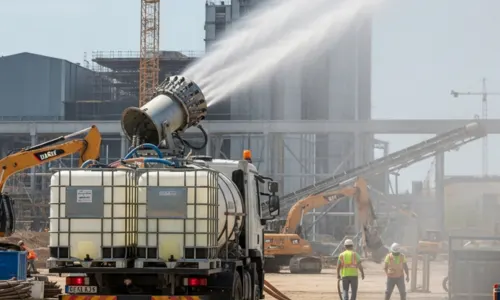
Long-throw coverage for stockpiles and yards.
ExploreWorker heat-stress cooling
Cooling stations, rest areas and gates.
ExploreIndustrial mist cooling
Cooler workshops, halls and work zones.
ExploreMisting fans
Portable spot cooling where lines cannot be fixed.
ExploreHow we work
From site survey to after-sales support
Survey & brief
We review the area, climate, water, power and the problem you need to solve — on site or from photos and drawings.
Engineering design
Pump size, pressure, nozzle type and spacing, line routing, filtration and controls are selected for your site.
Supply & installation
Our team installs and commissions the system, tests every zone and trains your operators.
Maintenance & spares
Scheduled AMC visits, filters, nozzles and pump spares keep the system performing season after season.
Related solutions
FAQ
Frequently asked questions
Will dust suppression add moisture to the cement?
Dry-fog systems are designed to add very little moisture — typically a fraction of a percent at the treated point — which is why they are preferred near moisture-sensitive materials.
Can you work under our permit-to-work and HSE procedures?
Yes. We prepare method statements and risk assessments, follow site induction and permit-to-work rules, and coordinate shutdown windows with your operations team.
What water quality does a misting system need?
Fine nozzles need clean, filtered water. In most GCC sites we fit sediment and inline filters and, where water is hard, a scale-inhibiting filter or an RO supply. Treated water protects nozzles and pumps and keeps maintenance predictable.
Do you supply and install outside Qatar?
Yes. S Flo Trading and Contracting WLL is based in Doha and delivers TrueMIST projects across the GCC, working with associates in Bahrain, the UAE and Saudi Arabia and supporting projects in Oman and Kuwait. Share your location and we will confirm the delivery and installation route.
Next step
Tell us about your site — we will recommend the right system
Share the area, the problem (heat, dust, odour or humidity) and a few photos. Our engineers reply with a recommended approach, layout and budget estimate — usually within one working day.